Subscribe to continue reading
Subscribe to get access to the rest of this post and other subscriber-only content.

Subscribe to get access to the rest of this post and other subscriber-only content.

In the world of Machine Learning (ML) and Artificial Intelligence (AI), the quality of the final model is a direct reflection of the quality of its training data. And at the heart of quality data lies data annotation. If data annotation is the process of labeling raw data to give AI a sense of “sight” or “understanding,” then the Data Annotation Rubric is the non-negotiable set of rules that governs that process. It is the single most critical document that ensures consistency, accuracy, and fidelity across millions of data points, bridging the gap between human understanding and machine logic.
More than ever, annotators are required to master rubrics, and many annotation platforms ask freelancers to learn and apply the rules very quickly and precisely. This article will tackle this important topic by explaining what rubrics are and why they matter and, as usual, proposing some tips and recommendations.
Whether you’re a beginner just starting your journey as a freelance annotator or a seasoned data scientist struggling to scale your quality assurance (QA) process, mastering the rubric is the key to unlocking better models and better career opportunities.
A data annotation rubric is a structured scoring system or checklist used to assess the quality of labels applied to data based on predefined, objective criteria. Think of it as the ultimate source of truth, moving beyond general project guidelines to provide granular, measurable standards for what constitutes a “correct” or “high-quality” annotation.
While Annotation Guidelines tell you how to annotate (e.g., “Use a bounding box for cars”), the Rubric tells you how well the annotation meets the project’s quality bar (e.g., “A bounding box must be snug to the object with a maximum of 3 pixels of padding”).
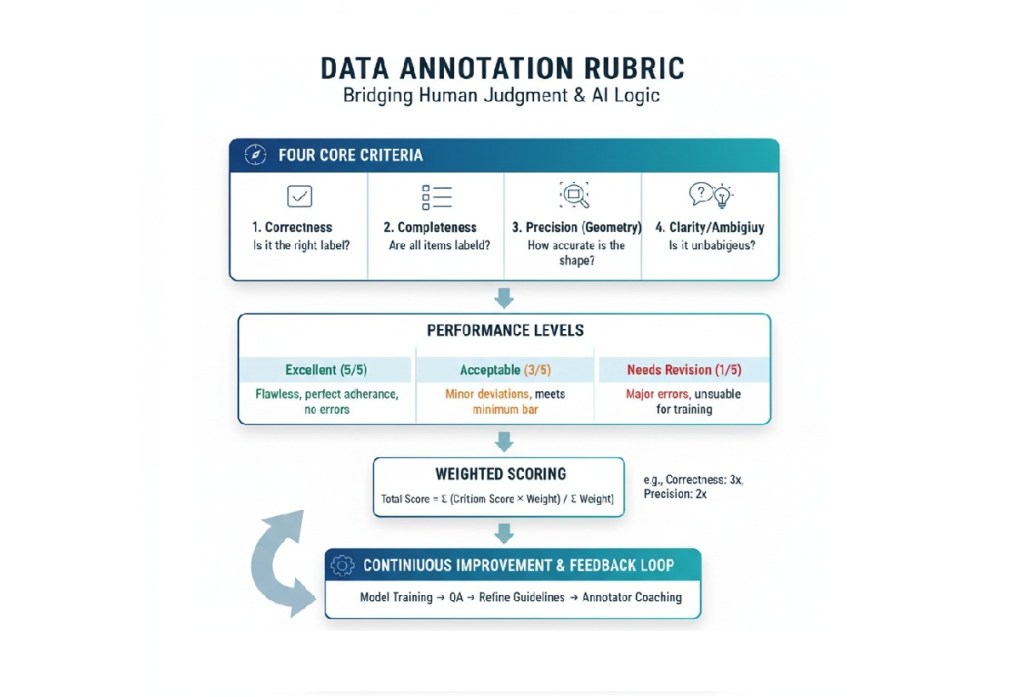
Rubrics break down the abstract concept of “quality” into quantifiable dimensions. While every project is unique, a solid rubric typically evaluates these four core criteria:
| Rubric Criterion | Question it Answers | Example for an Image Bounding Box Task |
| Correctness | Does the label/class match the object in the data? | Is the object labeled ‘Truck’ actually a truck, or is it a bus? |
| Completeness | Are all required features or entities labeled? | Are all pedestrians in the frame labeled, or was one missed? |
| Precision (Geometry) | Is the shape/location of the annotation accurate? | Is the bounding box tight around the object, or does it include too much background space? |
| Clarity/Ambiguity | Is the annotation clear and unambiguous for downstream use? | Does the annotator use the ‘Unsure’ tag correctly for blurry images, or is a clear object incorrectly flagged as ‘Unsure’? |
A good rubric will not only define these criteria but will also include performance levels (e.g., Excellent, Acceptable, Needs Revision) with detailed, descriptive text for each level, making quality assessment objective rather than subjective.
In the high-stakes environment of AI development—where data errors can lead to everything from frustrating user experiences to dangerous outcomes in self-driving cars or medical diagnostics—rubrics are essential for both people and models. Here are three key points to consider.
The Bedrock of Model Accuracy
Garbage In, Garbage Out (GIGO). Your machine learning model is only as smart as the data you feed it. Data errors can reduce AI performance by up to 30%. A robust rubric ensures the data used for training is high-fidelity Ground Truth.
Consistency Across the Workforce
Data annotation projects often involve large teams, sometimes hundreds or thousands of annotators and Quality Assurance (QA) specialists. Different people have different interpretations.
Efficiency in the Human-in-the-Loop Workflow
For project managers and data scientists, the rubric is a powerful QA tool that goes beyond simple statistical metrics (like overall accuracy).
If you’re a new data annotator, the rubric can seem intimidating, but mastering it is the most direct path to becoming a high-performing, high-value asset.
Treat the Rubric as Your Bible
Never, ever start annotating a task without thoroughly reading the entire rubric and its accompanying guidelines.
For example, a guideline might say “label all cars.” The rubric will clarify:
Criterion: Precision. Acceptable: Bounding box must be within 5 pixels of the object outline. Unacceptable: Box cuts into the object or extends more than 10 pixels outside.
Focus on the Descriptors
A rubric is a grid. Pay the most attention to the Performance Descriptors—the text blocks that describe each score level (e.g., “Excellent,” “Good,” “Poor”).
Annotate a Small Sample and Self-Score
Before tackling large batches, take 10-20 examples. Apply your labels, and then critique your own work using the rubric as if you were the QA lead.
| Your Annotation | Rubric Criterion | Your Self-Score | Key Takeaway |
|---|---|---|---|
| Car Bounding Box | Precision | Acceptable (3/5) | Need to be tighter; box is 7 pixels out. |
| Text Sentiment | Correctness | Excellent (5/5) | The phrase ‘not too bad’ is correctly classified as ‘Neutral.’ |
| Missing Object | Completeness | Needs Revision (1/5) | Forgot to label a partially occluded bike. Must re-read occlusion rules. |
This self-assessment builds the critical judgment that separates a fast annotator from a high-quality annotator.
For experienced professionals—freelancers seeking higher-paying, more complex projects or data scientists designing the QA workflow—mastering the rubric shifts from following rules to creating and refining them.
The most effective rubrics are typically analytic rubrics, which break quality down by multiple criteria, rather than holistic rubrics (which provide a single score). Creating one involves several key steps:
A. Align Criteria to Model Requirements
The rubric criteria must directly support what the downstream ML model needs to learn.
B. Define the Levels of Performance
Use clear, measurable, and actionable language for the performance levels. Avoid vague terms.
| Performance Level | Example Descriptor (for Polygon Precision) |
| Gold Standard (5) | The polygon follows the visible object perimeter with zero pixel deviation except where occlusion occurs. |
| Acceptable (3) | The polygon follows the perimeter but has a maximum of 2-pixel deviation or minor corner rounding. |
| Needs Re-Annotation (1) | The polygon cuts into the object or extends more than 3 pixels past the perimeter. |
C. Implement Adjudication and Weighting
In large-scale projects, not all errors are equal. The rubric must reflect this via a weighted scoring system.
The rubric should also include an Adjudication Strategy to resolve conflicts when multiple annotators disagree on a label. This might involve a consensus vote or sending the data point to a designated Domain Expert for final “Gold Label” creation.
For a freelance data annotator, moving beyond simple task completion to true proficiency means higher pay, more complex work, and greater job security. The rubric is your secret weapon.
| Skill Development Area | How the Rubric Guides Improvement |
| Attention to Detail | Internalize the Precision Criteria. Instead of simply labeling, you are now performing a quality check on your own work against the high standard set in the rubric. This shift from labeler to QA specialist is invaluable. |
| Time Management | Identify Your Bottlenecks. When you self-score, note which criteria you struggle with and how much time you spend on them. If precision takes too long, practice geometry tools. If completeness is an issue, develop a systematic scanning pattern. |
| Critical Thinking | Master the Edge Cases. High-value tasks often revolve around ambiguity (e.g., is a partially obscured item visible enough to label?). The rubric forces you to think critically, applying specific rules to unique, complex scenarios. You move from what is it? to how does the rule apply here? |
| Communication | Clarity in Queries. When you encounter a truly ambiguous data point, your communication with the project manager should reference the rubric. Instead of “I’m confused,” you say: “On item #123, the object meets the visibility threshold for ‘Occluded,’ but the geometry violates the ‘Minimum Pixels’ rule. Should I prioritize the bounding box rules or the visibility rules?” This level of specificity marks you as a true professional. |
For project leads and data scientists, the rubric is the framework for a robust QA process. Its implementation is what protects the integrity of the training data.
IAA is the statistical measure of how often different annotators agree on the label for the same piece of data.
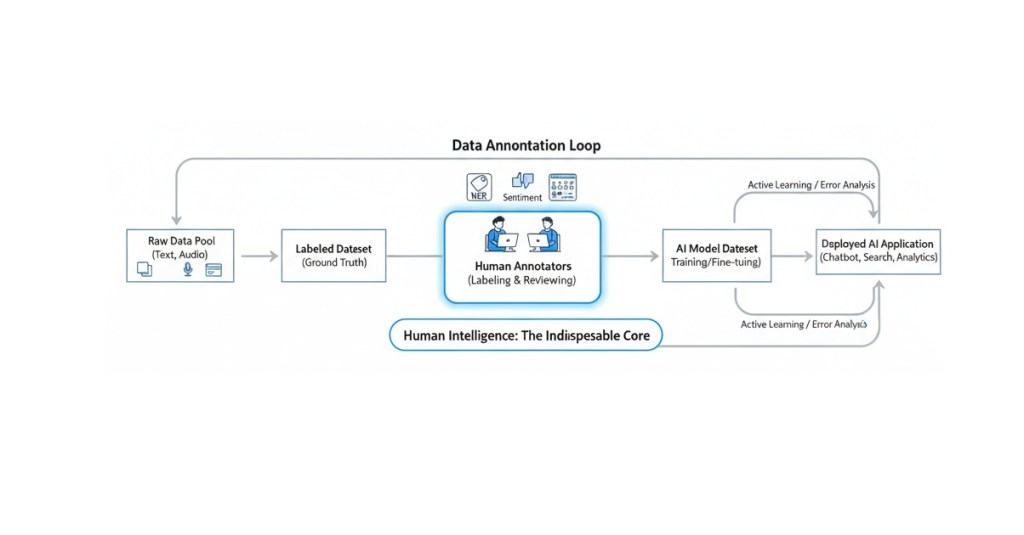
In modern AI workflows, annotation is not a one-time step but a continuous loop.
As AI models become more complex (e.g., multimodal, generative AI), the annotation tasks become increasingly subjective (e.g., ranking conversational quality, assessing ethical alignment). This shift makes the qualitative judgment enabled by a strong rubric more crucial than ever before.
The most successful data annotators and data teams will be those who view the rubric not as a punitive checklist, but as the scientific definition of data quality. Mastering its criteria, applying them consistently, and even participating in their creation is how you ensure that your contribution to the ML pipeline is foundational, reliable, and high-value.
What about your experience with rubrics? Comment and share your thoughts below!

In the rapidly evolving world of artificial intelligence (AI) and machine learning (ML), prompt engineering has emerged as a critical skill that bridges human intent with machine intelligence. For those looking to break into or advance in the field of data annotation for AI and ML, understanding prompt engineering is not just an asset—it’s a game-changer.
Data annotation has always been about creating training datasets that help AI systems understand and interpret information correctly. Prompt engineering extends this concept into the realm of generative AI, where instead of labeling data for future training, we’re crafting instructions that guide AI models to produce desired outputs in real-time.
The synergy between these fields is profound. Traditional data annotation taught us to think systematically about how machines interpret information—understanding edge cases, maintaining consistency, and ensuring quality at scale. These same principles form the foundation of effective prompt engineering, making data annotators naturally positioned to excel in this emerging field.
This article explores the relevance of prompt engineering in data annotation, offers practical tips to get proficient, and provides a clear learning path to help both newcomers and seasoned professionals thrive.
Prompt engineering is the art and science of crafting precise inputs (prompts) to guide large language models (LLMs) and other AI systems to produce accurate, relevant, and contextually appropriate outputs. Think of it as designing the perfect question or instruction to get the most useful response from an AI model. This skill is pivotal in applications ranging from content generation to complex problem-solving, and it’s increasingly integral to data annotation workflows. In data annotation, prompt engineering enhances the efficiency and quality of labeled datasets, which are the backbone of AI and ML models. For example, annotators might use well-crafted prompts to guide AI tools in generating initial labels for text, images, or videos, which humans then refine. This hybrid approach—combining AI-assisted annotation with human oversight—reduces manual effort, speeds up workflows, and improves accuracy. In industries like healthcare, where annotators label medical records or images for diagnostics, or in retail, where sentiment analysis drives customer insights, prompt engineering ensures AI tools produce high-quality, context-specific annotations. The synergy between prompt engineering and data annotation lies in their shared goal: creating high-quality, structured data to train AI models. As businesses generate massive volumes of unstructured data—over 3 quintillion bytes daily—prompt engineering helps annotators preprocess and label this data efficiently, enabling AI systems to deliver actionable insights.
Becoming proficient in prompt engineering requires a structured approach to skill development. The most successful practitioners combine technical understanding with creative problem-solving abilities.
Start with understanding how large language models work conceptually. You don’t need to dive deep into transformer architectures, but grasping concepts like context windows, token limitations, and attention mechanisms will inform better prompt design decisions. Familiarize yourself with different AI model types—from GPT variants to specialized models for code generation, image creation, and domain-specific applications.
Master the fundamental prompt patterns that form the backbone of effective AI communication. Zero-shot prompting involves giving the AI a task without examples, relying on clear instructions and context. Few-shot prompting provides examples within the prompt to guide the model’s understanding of desired output format and style. Chain-of-thought prompting encourages the AI to show its reasoning process, particularly valuable for complex analytical tasks.
Learn to structure prompts with clear roles, context, and constraints. A well-structured prompt typically includes the role you want the AI to assume, relevant background information, the specific task or question, and any constraints or formatting requirements for the output.
Develop expertise in prompt chaining, where complex tasks are broken down into sequential prompts that build upon each other. Master the art of prompt optimization through systematic testing and iteration. Learn to identify and mitigate common pitfalls like hallucination, bias amplification, and context drift.
Focus on developing expertise in specific domains where your data annotation background provides an advantage. Healthcare, legal, financial services, and technical documentation all have unique requirements and compliance considerations that reward specialized knowledge.
Apply your data annotation quality mindset to prompt engineering. Develop systematic approaches to testing prompts across different scenarios, edge cases, and model versions. Learn to create evaluation frameworks that measure prompt effectiveness objectively.
The path from data annotation to prompt engineering expertise can be navigated strategically with the right approach and timeline.
Begin with understanding the landscape of generative AI and its applications. Take introductory courses on large language models and their capabilities. Practice basic prompt engineering with freely available tools like ChatGPT, Claude, or Gemini. Start a prompt engineering journal documenting your experiments, what works, and what doesn’t.
Focus on translating your data annotation experience into prompt engineering concepts. If you’ve worked on image annotation, explore how to prompt image generation models. If you’ve done text classification, practice prompts that require similar categorization and analysis tasks.
Deepen your technical understanding through structured learning. You can enroll in comprehensive prompt engineering courses that cover advanced techniques and real-world applications. Practice with different model types and APIs to understand their unique characteristics and optimal prompting strategies.
Start building a portfolio of prompt engineering projects that demonstrate your capabilities. Create prompts for tasks similar to your data annotation work, showing how you can guide AI to perform quality analysis, content categorization, or data extraction tasks.
Choose a specialization area that aligns with your existing domain knowledge from data annotation work. Develop deep expertise in prompt engineering for that specific field, and create comprehensive case studies showing before-and-after results of your prompt optimization work.
Begin contributing to the prompt engineering community through blog posts, open-source projects, or community forums. This visibility helps establish your expertise and can lead to networking opportunities.
Start applying for prompt engineering roles, emphasizing your unique background in data quality and AI training data preparation. Consider hybrid roles that combine data annotation oversight with prompt engineering responsibilities (many companies need professionals who can bridge traditional ML training pipelines with new generative AI applications). Network with professionals who have made similar transitions. Join prompt engineering communities, attend AI conferences, and participate in hackathons or competitions that showcase prompt engineering skills.
The prompt engineering landscape is rapidly evolving, with several key trends defining its future direction. One of the most significant trends in prompt engineering is the use of mega-prompts. Unlike traditional short prompts, mega-prompts are longer and provide more context, which can lead to more nuanced and detailed AI responses.
Generative AI prompt creation is a new trend in prompt engineering, where AI systems help create and optimize prompts for specific use cases. This meta-application of AI creates opportunities for prompt engineers to focus on higher-level strategy and quality assurance rather than manual prompt crafting.
In 2025, generative models are increasingly being used to pre-label data, which human annotators can then refine, significantly reducing the time and effort required for large-scale projects. This trend directly impacts data annotation professionals, creating hybrid roles that combine traditional annotation oversight with prompt engineering for automated labeling systems.
The field is maturing beyond conversational AI into systematic product integration. Companies need prompt engineers who can design prompts that work reliably at scale, integrate with existing software systems, and maintain consistent performance across different use cases and user scenarios.
As AI models become capable of processing multiple input types simultaneously—text, images, audio, and code—prompt engineers must develop skills in crafting prompts that effectively utilize these multimodal capabilities.
Success in prompt engineering requires a combination of technical skills, creative thinking, and strategic career positioning. Leverage your data annotation background as a unique differentiator in the market. Your experience with quality control, edge case identification, and systematic testing translates directly to prompt engineering excellence.
Develop a systematic approach to prompt iteration and optimization. Document your methods, measure results quantitatively, and build repeatable processes that can scale across different projects and clients. This operational mindset, familiar from data annotation work, sets professional prompt engineers apart from casual practitioners.
Stay current with the rapidly evolving AI landscape. Follow key researchers, join professional communities, and experiment with new models and techniques as they become available. The field changes quickly, and continuous learning is essential for long-term success.
Build cross-functional skills that complement your prompt engineering expertise. Understanding of APIs, basic programming concepts, data analysis, and project management will make you more valuable to employers and clients.
Consider the broader implications of AI systems in your prompt engineering work. Understanding ethical AI principles, bias mitigation, and responsible AI deployment will become increasingly important as these systems are integrated into critical business processes.
Prompt engineering is more than a buzzword—it’s a transformative skill that empowers data annotators to unlock the full potential of AI and ML. By mastering prompt design, you can streamline annotation workflows, improve model performance, and position yourself as a valuable asset in a rapidly growing job market. With the prompt engineering market projected to soar to USD 2.06 billion by 2030 and the data annotation market expected to reach USD 8.22 billion by 2028, now is the time to invest in this skill.
Start with foundational AI knowledge, practice crafting effective prompts, and pursue continuous learning through courses and hands-on projects. Whether you’re annotating datasets for autonomous vehicles or optimizing customer insights in retail, prompt engineering will set you apart in the AI revolution. Take the first step today—your career in data annotation and AI awaits!
Ready to dive into prompt engineering? Share your favorite prompt design tips or job market insights in the comments below.
For more resources, check out our blog’s guides on data annotation and AI career paths!

The data annotation industry stands at a fascinating crossroads. As artificial intelligence continues its rapid evolution, the demand for high-quality labeled data has never been higher, yet the methods and requirements for annotation work are transforming at an unprecedented pace.
We already discussed in previous articles how important annotation is in AI and Machine Learning, because it provides the labeled data necessary for models to learn, understand, and make accurate predictions from real-world information.
AI is a rapidly evolving field, and annotation remains vital as it continuously adapts to keep up with the emerging trends and provide the diverse, high-quality labeled data that fuels the accelerated development and sophistication of new models, from generative AI to advanced computer vision.
Whether you’re just starting your journey as a data annotator or you’re a seasoned professional looking to stay ahead of the curve, understanding these emerging trends isn’t just beneficial—it’s essential for long-term success in this dynamic field.
Before diving into future trends, it’s crucial to understand where we stand today. The global data annotation market has experienced explosive growth, driven by the AI boom across industries from healthcare to autonomous vehicles. Traditional annotation tasks—image labeling, text classification, and audio transcription—have formed the backbone of this industry. However, the landscape is shifting rapidly, and those who adapt will thrive while others may find themselves left behind.
The annotation work of tomorrow will be more sophisticated, more specialized, and paradoxically, more collaborative with AI systems than ever before. This evolution presents both challenges and tremendous opportunities for annotators willing to embrace change.
Perhaps the most significant trend reshaping data annotation is the emergence of human-AI collaborative workflows. Rather than replacing human annotators, AI systems are increasingly working alongside them to enhance efficiency and accuracy. This symbiotic relationship is fundamentally changing how annotation work is performed.
Pre-labeling systems powered by machine learning models now provide initial annotations that human annotators refine and correct. This approach can reduce annotation time by 60-80% while maintaining or even improving quality. Advanced platforms use active learning algorithms to identify the most valuable data points for human review, ensuring that annotators focus their expertise where it matters most.
The implications for annotators are profound. Success in this new paradigm requires developing skills in AI-assisted workflows, understanding when to trust automated suggestions, and knowing how to efficiently correct machine-generated labels. Annotators who master these hybrid approaches will become invaluable assets to organizations seeking to scale their data operations.
As AI systems become more sophisticated at handling basic annotation tasks, the demand for specialized, domain-specific expertise is surging. Medical image annotation, legal document analysis, and scientific data labeling require deep subject matter knowledge that general-purpose AI cannot yet match.
This trend is creating lucrative opportunities for annotators with specialized backgrounds. A radiologist who can annotate medical imaging data, a lawyer who can label legal documents, or a biologist who can classify scientific specimens can command premium rates and enjoy stable, long-term employment prospects.
The key to capitalizing on this trend is identifying your unique expertise and positioning yourself within a specific niche. Even if you don’t have formal credentials in a particular field, developing demonstrable knowledge through coursework, certification programs, or hands-on experience can open doors to higher-paying specialized roles.
Synthetic data, generated by tools like GANs or diffusion models, is increasingly used to augment real datasets. Annotators are tasked with validating or refining labels for synthetic data, which is often used to address data scarcity or bias.
Synthetic data reduces reliance on costly real-world data collection, but it requires human validation to ensure quality. Annotators who can work with synthetic data will play a key role in scalable AI development.
Tips to get ready:
Annotators who can validate and refine synthetic data will be essential for projects aiming to scale datasets efficiently while maintaining accuracy.
The rise of real-time AI applications is creating demand for annotation of streaming data. Unlike traditional batch processing, these applications require annotators to work with continuous data streams, often under tight time constraints. This trend is particularly prominent in areas like social media monitoring, financial trading systems, and autonomous vehicle development.
Real-time annotation requires different skills than traditional batch processing. Annotators must be able to make quick, accurate decisions while maintaining consistent quality standards. They need to understand the downstream impact of their work on live systems and be comfortable working in high-pressure environments where their annotations directly influence active AI systems.
This emerging field offers exciting opportunities for annotators who can adapt to faster-paced workflows while maintaining accuracy. The compensation for real-time annotation work is often significantly higher than traditional batch processing, reflecting the specialized skills and pressure involved.
The future of AI is multimodal, combining text, images, audio, and video in sophisticated ways. This evolution is driving demand for annotators who can work across multiple data types simultaneously. Rather than specializing in a single modality, the most successful annotators of the future will be those who can seamlessly navigate between different types of data.
Multimodal annotation tasks might involve labeling objects in images while also annotating the corresponding text descriptions, or synchronizing audio transcripts with video timestamps while identifying speakers and emotions. These complex tasks require a broader skill set and deeper understanding of how different data types interact.
Developing multimodal capabilities requires deliberate practice and often additional training. However, annotators who invest in these skills will find themselves uniquely positioned to handle the most challenging and well-compensated annotation projects.
As AI systems become more prevalent in critical applications, the focus on ethical AI and bias mitigation is intensifying. This trend is creating new roles for annotators who specialize in identifying and correcting biases in training data. These professionals need to understand not just how to label data accurately, but also how to recognize when datasets may perpetuate harmful biases or fail to represent diverse populations adequately.
Bias-aware annotation requires cultural sensitivity, understanding of social dynamics, and knowledge of how different groups might be affected by AI systems. Annotators working in this area often collaborate with ethicists, social scientists, and community representatives to ensure that datasets are fair and inclusive.
This emerging field offers opportunities for annotators who are passionate about social justice and want to contribute to more equitable AI systems. The work is both intellectually challenging and socially meaningful, making it attractive to professionals seeking purpose-driven careers.
The rapid pace of change in data annotation means that continuous learning isn’t optional—it’s essential. Successful annotators invest regularly in updating their skills, learning new tools, and staying current with industry developments. This might involve taking online courses, attending industry conferences, or participating in professional development programs offered by annotation platforms.
Create a personal learning plan that includes both technical skills and domain knowledge. Set aside time each week for skill development, and don’t hesitate to experiment with new tools and techniques. The annotation professionals who thrive are those who view learning as an ongoing process rather than a one-time event.
Rather than focusing exclusively on a single type of annotation, develop competencies across multiple areas. This diversification provides flexibility and makes you more valuable to potential employers. Consider building expertise in both high-volume, efficiency-focused tasks and specialized, high-value annotation work.Your portfolio might include proficiency in standard image labeling, experience with specialized medical annotation, familiarity with multimodal tasks, and knowledge of quality assurance processes. This breadth of skills makes you adaptable to changing market demands and positions you for a wider range of opportunities.
Understanding the technical context of your annotation work is becoming increasingly important. While you don’t need to become a machine learning expert, having a basic understanding of how AI models use annotated data can make you more effective and valuable.
Learn about common machine learning concepts, understand how different types of annotations affect model performance, and familiarize yourself with the tools and platforms used in AI development. This knowledge will help you make better annotation decisions and communicate more effectively with technical teams.
As annotation work becomes more collaborative and quality-focused, soft skills are becoming increasingly valuable. Communication skills help you work effectively with team members and provide useful feedback to improve processes. Attention to detail and consistency are crucial for maintaining high quality standards. Time management and organization enable you to handle complex projects efficiently.Don’t overlook the importance of adaptability and problem-solving skills. The annotation industry is constantly evolving, and professionals who can quickly adapt to new requirements and find creative solutions to challenges will have significant advantages.
The annotation community is growing rapidly, but it’s still relatively small and interconnected. Building relationships with other professionals in the field can provide valuable insights into industry trends, job opportunities, and best practices. Participate in online forums, attend virtual meetups, and engage with annotation platforms’ community features.
Consider mentoring newcomers to the field while also seeking mentorship from more experienced professionals. These relationships can provide valuable learning opportunities and help you stay connected to industry developments.
Stay informed about industry developments by following relevant publications, blogs, and research papers. Key resources include AI research journals, industry reports from companies like McKinsey and Gartner, and specialized blogs focused on machine learning and data science.
Set up Google Alerts for keywords related to data annotation, AI training data, and machine learning datasets. This automated approach ensures you don’t miss important developments even when you’re busy with annotation work.
Most major annotation platforms regularly publish insights about industry trends and best practices. Follow these platforms on social media, subscribe to their newsletters, and participate in their webinars and training sessions. These resources often provide early insights into emerging trends and new annotation techniques.Join professional communities or specialized groups on LinkedIn and Reddit. These communities are excellent sources of peer insights and practical advice from experienced annotators.
Don’t wait for formal training to explore new annotation tools and technologies. Many platforms offer free trials or demo versions that allow you to experiment with new features and capabilities. This hands-on experience can give you a competitive advantage when these tools become mainstream.
Consider setting up personal projects to test new annotation techniques or tools. This experimentation can help you identify emerging trends early and develop expertise before they become widely adopted.
While not always necessary, relevant certifications can demonstrate your commitment to professional development and validate your skills to potential employers. Look for certifications in areas like machine learning, specific annotation tools, or domain-specific knowledge relevant to your specialization.
Many universities and online platforms now offer courses specifically focused on data annotation and AI training data. These programs can provide structured learning opportunities and help you build connections with other professionals in the field.
The future of data annotation is bright, but it will look significantly different from today’s industry. Successful annotators will be those who embrace change, continuously develop their skills, and position themselves as valuable partners in the AI development process rather than simply data processors.
The most successful annotation professionals of the future will likely be those who can seamlessly blend human expertise with AI capabilities, work effectively across multiple data modalities, and contribute to the ethical development of AI systems. They’ll be skilled communicators who can work effectively in diverse teams and adapt quickly to new requirements and technologies.
As the industry continues to evolve, remember that your value as an annotator lies not just in your ability to label data accurately, but in your capacity to understand context, apply judgment, and contribute to the broader goals of AI development. By staying informed about trends, continuously developing your skills, and positioning yourself as a strategic partner in the AI development process, you can build a rewarding and sustainable career in this exciting field.
The future of data annotation is full of opportunities for those ready to embrace change and growth. Whether you’re just starting your annotation journey or looking to advance your existing career, now is the time to invest in the skills and knowledge that will define success in tomorrow’s annotation landscape.
Share your thoughts in the comments below!

Becoming a data annotator is an exciting entry point into the AI and machine learning industry, offering flexible, remote work with a low barrier to entry. However, to excel in this role you need to build specific skills, understand annotation tools, and navigate the nuances of crowdsourcing platforms. Navigating the initial learning curve can feel a bit overwhelming, that’s why we’ve put together an ideal 8-week study plan focusing on the foundational knowledge you’ll need to confidently step into the data annotation landscape, whether you’re aiming for freelance gigs or in-house roles. This article outlines the main content and purpose of a study plan for aspiring data annotators, combining courses from e-learning platforms like Coursera and Udemy, free resources, and practical steps to get you job-ready in just 8 weeks.
Data annotation involves labeling data (e.g., images, text, audio) to train AI models, requiring attention to detail, basic tech skills, and familiarity with annotation tools. A structured study plan helps you:
This initial phase is all about grasping the “what” and “why” of data annotation. You’ll build a foundational understanding of its role in the broader AI and machine learning ecosystem.
Learning Objectives: Understand the definition of data annotation, its purpose, and the different types of data that are annotated (images, text, audio, video, etc.). Recognize the importance of high-quality annotations for machine learning model performance.
Resources:
Key Takeaways: Data annotation is the process of labeling data to make it understandable for machine learning algorithms. Accurate and consistent annotations are crucial for building reliable AI models.
Learning Objectives: Understand how annotated data is used to train machine learning models (supervised learning). Learn about different machine learning tasks that rely on data annotation (e.g., image classification, object detection, natural language processing, sentiment analysis).
Resources:
Search for “supervised learning explained simply” or “how machine learning uses labeled data.”
Key Takeaways: Annotated data acts as the “ground truth” that teaches machines to recognize patterns and make predictions. Different machine learning tasks require specific types of annotations.
Learning Objectives: Become familiar with the names and basic functionalities of popular data annotation tools. Understand the difference between in-house tools and third-party platforms.
Resources:
Key Takeaways: Various tools exist, each with its own strengths and weaknesses. Familiarity with common features will be helpful when you start working on projects.
This phase shifts to acquiring hands-on experience and understanding the nuances of different annotation types.
Learning Objectives: Learn about different image annotation techniques like bounding boxes, polygons, semantic segmentation, and keypoint annotation. Understand the importance of precision and consistency in image annotation.
Recommended Courses (Paid):
Free Resources:
Key Takeaways: Different computer vision tasks require different image annotation techniques. Accuracy and adherence to guidelines are paramount.
Learning Objectives: Learn about different text annotation techniques like named entity recognition (NER), sentiment analysis, text classification, and relationship extraction. Understand the importance of context and linguistic understanding in text annotation.
Recommended Courses (Paid):
Free Resources:
Key Takeaways: Text annotation requires understanding the meaning and context of the text. Different NLP tasks rely on specific text annotation methods.
Learning Objectives: Gain a basic understanding of audio transcription, speaker diarization, and video object tracking. Recognize the unique challenges associated with annotating these data types.
Free Resources:
Key Takeaways: Audio and video annotation often involve time-based labeling and require specialized tools and techniques.
This phase focuses on refining your skills, understanding the professional landscape, and continuously learning.
Learning Objectives: Recognize the importance of clear and detailed annotation guidelines. Understand the concept of inter-annotator agreement and quality control processes.
Free Resources:
Key Takeaways: Adhering to guidelines is essential for producing high-quality annotations. Understanding quality assurance processes will help you deliver accurate work.
Learning Objectives: Familiarize yourself with popular freelancing platforms that list data annotation jobs (e.g., Upwork, Data Annotation Tech, Amazon Mechanical Turk, Outlier). Understand how to create a compelling profile and bid on projects.
Free Resources:
Key Takeaways: The freelance market offers numerous data annotation opportunities. A strong profile and targeted bidding are key to securing projects.
Consolidate your learning, create a portfolio, and tailor your resume for annotation roles. Join platforms and prepare for real-world tasks.
Canva (Free Tier): Use Canva to create visually appealing resume and portfolio documents.
GitHub (Free): If you’ve practiced with open-source tools and datasets, create a GitHub repository to showcase your practice projects (e.g., a small annotated dataset you created, a script you used for a mini-project).
Portfolio Ideas:
Interview Preparation:
Practice answering common interview questions, especially those related to attention to detail, problem-solving, and your understanding of AI’s importance.
Be ready to discuss your experience with different annotation tools and data types.
Emphasize your commitment to accuracy and quality.
The AI landscape evolves rapidly. After your initial 8-week sprint, commit to continuous learning:
This 8-week study plan is your launchpad. With dedication and the right resources, you can confidently step into the in-demand world of data annotation and AI training, contributing to the future of artificial intelligence.
Ready to start? Share your progress or questions in the comments!