Author: Data Annotation Hub

  • Leveraging Project Management Expertise for Data Annotation and AI Training Success in 2025

    Leveraging Project Management Expertise for Data Annotation and AI Training Success in 2025

    8–12 minutes

    Data annotation and AI training are critical to developing robust AI models, powering applications from autonomous vehicles to medical diagnostics. As the AI industry surges—projected to reach a $1.8 trillion market by 2030—effective project management is essential to streamline complex workflows, ensure high-quality datasets, and meet tight deadlines.
    The precision of AI models hinges on the quality of their training data. And ensuring that data is meticulously prepared, labeled, and refined at scale falls squarely on the shoulders of skilled project managers. Far from a purely technical role, project management in data annotation and AI training is a dynamic blend of logistical prowess, team leadership, and a keen understanding of AI’s ethical implications.
    If you’re an experienced annotator looking to climb the career ladder, or a project management professional eager to dive into the cutting-edge of AI, this field offers immense opportunity. Let’s explore what it takes to excel, navigate ethical challenges, and capitalize on the evolving landscape.

    Data annotation projects involve diverse stakeholders—clients, annotators, data scientists, and quality assurance teams—working across tasks like labeling images, tagging text, or evaluating AI outputs. These projects require meticulous planning, resource allocation, and quality control to deliver datasets that meet AI model requirements.

    At its core, managing data annotation and AI training projects is about orchestrating a complex process to deliver high-quality, relevant data to AI models. This involves:

    • Defining Scope & Guidelines: Collaborating with AI engineers and data scientists to translate AI model requirements into clear, unambiguous annotation guidelines. This is the blueprint for all annotation work.
    • Resource Allocation: Managing annotator teams (in-house or outsourced), ensuring they have the right skills, tools, and bandwidth for the project.
    • Workflow Optimization: Designing efficient annotation pipelines, leveraging appropriate tools, and implementing strategies to maximize productivity without sacrificing quality.
    • Quality Assurance & Control (QA/QC): Establishing rigorous QA processes, including inter-annotator agreement (IAA) metrics, spot checks, and feedback loops, to ensure consistent and accurate labeling.
    • Timeline & Budget Management: Keeping projects on schedule and within budget, adapting to unforeseen challenges, and communicating progress to stakeholders.
    • Troubleshooting & Problem Solving: Addressing annotation ambiguities, tool issues, and performance discrepancies as they arise.
    • Feedback Integration: Facilitating the crucial feedback loop between annotators and AI developers, ensuring that annotation strategies are refined based on model performance.

    Project management expertise ensures efficient workflows, mitigates risks, and aligns deliverables with client goals. With AI-related job postings growing 3.5x faster than overall jobs and offering 5–25% wage premiums, skilled project managers can command high earnings ($50–$150/hour) while driving impactful AI outcomes.

    Effective project management in data annotation requires a blend of traditional skills and AI-specific expertise. Below are the most critical skills and their applications:

    Planning and Scheduling

     Why Needed: Annotation projects involve tight timelines and large datasets (e.g., millions of images for computer vision). Planning ensures tasks are allocated efficiently across freelancers or teams.

    How Applied: Use tools like Asana or Jira to create timelines, assign tasks (e.g., image labeling, text tagging), and track progress. Break projects into phases (e.g., data collection, annotation, quality assurance).

    Example: A project manager schedules 100 annotators to label 10,000 images in two weeks, using milestones to monitor daily progress.

    Resource Management

    Why Needed: Balancing human resources (e.g., freelancers on platforms like Outlier AI) and tools (e.g., Label Studio) optimizes costs and efficiency.

    How Applied: Assign skilled annotators (e.g., coders for Python tasks) to high-priority projects and leverage free tools like CVAT for cost savings.

    Example: A manager allocates medical annotators to TELUS International’s healthcare projects, ensuring expertise matches task complexity.

    Stakeholder Communication

    Why Needed: Clear communication aligns clients, annotators, and data scientists on project goals, guidelines, and feedback.

    How Applied: Use Slack or Zoom for regular check-ins, share guidelines via shared docs, and provide clients with progress dashboards.

    Example: A manager hosts weekly QA sessions to clarify annotation guidelines for Mindrift’s AI tutoring tasks.

    Risk Management

    Why Needed: Risks like inconsistent annotations or missed deadlines can derail AI training. Proactive mitigation ensures quality and timeliness.

    How Applied: Identify risks (e.g., annotator turnover) and create contingency plans, such as cross-training or backup freelancers.

    Example: A manager anticipates task shortages on DataAnnotation.Tech and diversifies across Appen to maintain workflow.

    Quality Assurance (QA)

    Why Needed: High-quality datasets are critical for AI model accuracy. QA ensures annotations meet standards (e.g., 95% accuracy for medical imaging).

    How Applied: Implement overlap checks (e.g., multiple annotators label the same data) and use tools like Label Studio’s review features.

    Example: A manager uses CVAT’s review tools to verify bounding boxes in autonomous vehicle datasets.

    Technical Proficiency (AI and Data Knowledge)

    Why Needed: Understanding AI concepts (e.g., NLP, computer vision) and annotation tools enhances project oversight and client trust.

    How Applied: Learn basics of Python, ML frameworks, or annotation platforms (e.g., Doccano) to guide technical workflows and troubleshoot issues.

    Example: A manager uses Python scripts to automate data preprocessing for Alignerr, speeding up delivery.

    Ethical Decision-Making

    Why Needed: AI projects raise ethical concerns, such as bias in datasets or worker exploitation. Ethical management builds trust and compliance.

    How Applied: Ensure fair annotator pay, transparent guidelines, and bias-free datasets (e.g., diverse representation in facial recognition data).

    Example: A manager reviews datasets for gender or racial bias, consulting clients to align with ethical standards.

    For Newcomers to Project Management

    • Master the Fundamentals of Annotation: Before you can manage annotators, you need to understand their work. Spend time performing various annotation tasks (image, text, audio, video) and become proficient with popular tools (e.g., CVAT, Label Studio, custom platforms).
    • Gain Practical Project Experience: Start with smaller annotation projects. Offer to lead initiatives within your current annotation team or seek out entry-level project coordination roles.
    • Formal Project Management Training: Obtain certifications like the Certified Associate in Project Management (CAPM) or even the Project Management Professional (PMP) from the Project Management Institute (PMI). These provide a structured understanding of project methodologies.
    • Develop Strong Communication & Leadership Skills: Practice clear written and verbal communication. Learn how to motivate teams, resolve conflicts, and provide constructive feedback.
    • Understand AI Basics: While not a data scientist, a foundational understanding of machine learning concepts (supervised learning, model training, bias) will greatly enhance your ability to lead annotation projects effectively.

    For Experienced Annotators Looking to Lead

    • Deepen Your Domain Expertise: Leverage your hands-on annotation experience. You inherently understand the nuances, challenges, and subjective aspects of labeling. This gives you a unique advantage in creating precise guidelines and managing quality.
    • Take Initiative: Volunteer to train new annotators, propose improvements to existing workflows, or lead small internal projects. Show your leadership potential.
    • Learn Project Management Methodologies: While you may intuitively apply some PM principles, formal training (PMP, Agile certifications) will provide a robust framework for managing complex projects.
    • Sharpen Your Data Analysis Skills: Learn to analyze annotation data, track metrics (IAA, throughput, error rates), and use this data to inform decisions and improve efficiency. Basic Python or SQL can be incredibly useful here.
    • Develop Stakeholder Management Skills: Learn to communicate effectively with diverse stakeholders – from annotators on the ground to high-level AI researchers and product managers.

    Tackling Ethical Issues: A Guiding Principle

    Ethical considerations are paramount in data annotation and AI training. As a project manager, you are a crucial guardian of responsible AI development.

    Key Ethical Concerns

    • Bias and Discrimination: If training data reflects societal biases (e.g., underrepresentation of certain demographics in facial recognition datasets, skewed sentiment in language models), the AI model will perpetuate and even amplify those biases.
    • Privacy and Data Protection: Annotators often handle sensitive personal data (e.g., medical records, private conversations, identifiable images). Ensuring anonymization, secure handling, and compliance with regulations like GDPR is critical.
    • Annotator Well-being and Fair Labor: The repetitive nature of annotation can lead to burnout. Ensuring fair wages, reasonable workloads, and supportive working conditions for annotators is an ethical imperative.
    • Transparency and Accountability: Being transparent about data sources, annotation methodologies, and potential limitations of the dataset helps build trust in the resulting AI system.

    Recommendations for Project Managers

    • Diverse Data Sourcing: Actively seek diverse and representative datasets to mitigate bias. Work with data scientists to identify potential biases in source data.
    • Inclusive Guideline Development: Involve diverse annotators in the guideline creation process to capture different perspectives and reduce subjective biases.
    • Robust Privacy Protocols: Implement strict data anonymization, pseudonymization, and access control measures. Ensure annotators are trained on data privacy best practices.
    • Fair Compensation & Workload Management: Advocate for fair pay and reasonable project timelines to prevent annotator fatigue and ensure quality.
    • Continuous Bias Auditing: Regularly audit annotated data for signs of bias and implement corrective measures.
    • Annotator Training on Ethics: Educate annotators on the ethical implications of their work, emphasizing the impact of their labeling decisions on fairness and societal outcomes.
    • Document Everything: Maintain clear documentation of data sources, annotation processes, guideline changes, and QA results to ensure transparency and accountability.

    Career Opportunities and Trends

    The demand for skilled project managers in data annotation and AI training is on a steep upward curve. As AI becomes more sophisticated, so does the need for expertly curated data.

    Current and Emerging Career Opportunities

    • Data Annotation Project Manager / Lead: Overseeing annotation projects, managing teams, and ensuring quality.
    • AI Training Manager: More broadly focused on the entire AI training pipeline, including data collection, annotation, model evaluation, and feedback loops.
    • Data Quality Manager (AI/ML): Specializing in establishing and maintaining high data quality standards for AI models.
    • Annotation Solutions Architect: Designing and implementing complex annotation workflows and recommending tools.
    • Crowdsourcing Manager: Managing relationships with external annotation vendors and crowdsourcing platforms.
    • Human-in-the-Loop (HITL) Operations Lead: Managing the integration of human intelligence with automated AI processes for continuous model improvement.

    Key Trends Shaping the Field

    • Rise of Generative AI: The need to refine and align outputs from large language models (LLMs) and other generative AI with human preferences is creating new “human feedback” annotation roles (e.g., Reinforcement Learning from Human Feedback – RLHF).
    • Multimodal Data Annotation: Projects increasingly involve annotating combinations of data types (e.g., video with audio transcription and object detection), requiring more complex project management.
    • AI-Assisted Annotation: Smart tools that use AI to pre-label data are becoming standard, shifting the annotator’s role towards validation and refinement, and demanding project managers who can leverage these technologies.
    • Edge AI and Specialized Domains: Growth in AI applications for specific industries (healthcare, autonomous vehicles, manufacturing) requires annotators and project managers with domain-specific knowledge.
    • Focus on Explainable AI (XAI): As AI systems become more complex, there’s a growing need for data that helps explain their decisions, creating new annotation challenges.
    • Emphasis on Data Governance and Compliance: Stricter regulations around data privacy and AI ethics are making robust data governance and compliance a critical aspect of annotation project management.

    Becoming a proficient project manager in data annotation and AI training isn’t just about managing tasks; it’s about leading the charge in building responsible, effective, and impactful AI systems.
    Project management expertise is a game-changer in data annotation and AI training, aligning complex workflows, diverse teams, and client expectations. By mastering planning, resource management, QA, and ethical practices, you can excel in this $1.8 trillion industry.
    The world of data annotation and AI training is dynamic, impactful, and full of opportunity. Whether you’re just starting your journey or looking to elevate your existing skills, your contributions are vital to building smarter, more ethical AI.

    What are you waiting for?

    Join the conversation: Let us know what topics you’d like us to cover next to help you succeed in this exciting field! Dive into our 8-week study plan: Kickstart your career as an AI Annotator/Trainer today. Share your insights: Are you an experienced annotator or project manager? What tips or challenges have you encountered?


    Go back

    Your message has been sent

  • How to Become a Data Annotator: 8-Week Study Plan

    How to Become a Data Annotator: 8-Week Study Plan

    7–11 minutes

    Becoming a data annotator is an exciting entry point into the AI and machine learning industry, offering flexible, remote work with a low barrier to entry. However, to excel in this role you need to build specific skills, understand annotation tools, and navigate the nuances of crowdsourcing platforms. Navigating the initial learning curve can feel a bit overwhelming, that’s why we’ve put together an ideal 8-week study plan focusing on the foundational knowledge you’ll need to confidently step into the data annotation landscape, whether you’re aiming for freelance gigs or in-house roles. This article outlines the main content and purpose of a study plan for aspiring data annotators, combining courses from e-learning platforms like Coursera and Udemy, free resources, and practical steps to get you job-ready in just 8 weeks.

    Data annotation involves labeling data (e.g., images, text, audio) to train AI models, requiring attention to detail, basic tech skills, and familiarity with annotation tools. A structured study plan helps you:

    • Master essential skills like data labeling, tool usage, and time management.
    • Build a portfolio to showcase your work on platforms.
    • Understand AI ethics and industry context to stand out for higher-paying tasks.
    • Overcome challenges like low initial pay or task rejections by being well-prepared.

    This initial phase is all about grasping the “what” and “why” of data annotation. You’ll build a foundational understanding of its role in the broader AI and machine learning ecosystem.

    Learning Objectives: Understand the definition of data annotation, its purpose, and the different types of data that are annotated (images, text, audio, video, etc.). Recognize the importance of high-quality annotations for machine learning model performance.
    Resources:

    • Blog posts and articles (you can find a lot here on Data Annotation Hub!): Search online for terms like “what is data annotation,” “types of data annotation,” and “importance of data annotation in AI.” You’ll find numerous introductory articles explaining the concepts.
    • Introductory YouTube videos: Look for short, concise videos explaining data annotation workflows and its significance.


    Key Takeaways: Data annotation is the process of labeling data to make it understandable for machine learning algorithms. Accurate and consistent annotations are crucial for building reliable AI models.


    The Role of Data Annotation in Machine Learning

    Learning Objectives: Understand how annotated data is used to train machine learning models (supervised learning). Learn about different machine learning tasks that rely on data annotation (e.g., image classification, object detection, natural language processing, sentiment analysis).
    Resources:

    • Introductory machine learning resources: Many free online courses and articles offer a basic overview of supervised learning. Focus on the parts that explain training data. Platforms like Coursera and edX often have introductory modules you can audit for free. IBM offers a free training program introducing topics such as AI and data analysis.
    • Coursera: “Introduction to Data Science” by IBM – Provides a beginner-friendly overview of data science, including the role of data annotation in AI. Covers basic concepts like datasets, supervised learning, and data preprocessing.


    Search for “supervised learning explained simply” or “how machine learning uses labeled data.”
    Key Takeaways: Annotated data acts as the “ground truth” that teaches machines to recognize patterns and make predictions. Different machine learning tasks require specific types of annotations.


    Common Data Annotation Tools and Platforms

    Learning Objectives: Become familiar with the names and basic functionalities of popular data annotation tools. Understand the difference between in-house tools and third-party platforms.


    Resources:

    • Researching company websites: Explore the websites of popular data annotation platforms (e.g., Labelbox, Scale AI, Superannotate). While you might not get hands-on access immediately, understanding their features is beneficial.
    • Reading reviews and comparisons: Look for articles or forum discussions comparing different data annotation tools.


    Key Takeaways: Various tools exist, each with its own strengths and weaknesses. Familiarity with common features will be helpful when you start working on projects.

    This phase shifts to acquiring hands-on experience and understanding the nuances of different annotation types.


    Image Annotation Fundamentals

    Learning Objectives: Learn about different image annotation techniques like bounding boxes, polygons, semantic segmentation, and keypoint annotation. Understand the importance of precision and consistency in image annotation.


    Recommended Courses (Paid):

    • Udemy: Search for courses like “Image Annotation for Computer Vision” or “Object Detection and Image Segmentation.” Look for highly-rated courses with practical exercises.
    • Coursera: Explore courses within specializations like “Deep Learning” or “Computer Vision” that might include modules on data annotation.


    Free Resources:

    • Tutorials on specific annotation tools: Many annotation platforms offer free tutorials on how to use their tools for different image annotation tasks.
    • Practice datasets: Search for publicly available image datasets (e.g., on Kaggle or Roboflow Universe) that you can use to practice manual annotation using a free tool like LabelMe or CVAT (Computer Vision Annotation Tool).
    • LabelImg (Open-Source Tool): Download LabelImg (free on GitHub) to practice image annotation (e.g., drawing bounding boxes).
    • Khan Academy: “Intro to Data Representations”: Free lessons on data basics, including how data is structured for AI. Great for understanding annotation’s role.


    Key Takeaways: Different computer vision tasks require different image annotation techniques. Accuracy and adherence to guidelines are paramount.


    Text Annotation Fundamentals

    Learning Objectives: Learn about different text annotation techniques like named entity recognition (NER), sentiment analysis, text classification, and relationship extraction. Understand the importance of context and linguistic understanding in text annotation.


    Recommended Courses (Paid):

    • Udemy: Look for courses on “Natural Language Processing (NLP) Basics” or specific annotation types like “Named Entity Recognition with Python.”
    • Coursera: Explore courses within NLP specializations that cover text annotation.


    Free Resources:

    • NLP tutorials and articles: Numerous free resources explain concepts like NER and sentiment analysis.
    • Practice with free annotation tools: Explore free text annotation tools and practice labeling sample text data.


    Key Takeaways: Text annotation requires understanding the meaning and context of the text. Different NLP tasks rely on specific text annotation methods.


    Audio and Video Annotation (Introduction)

    Learning Objectives: Gain a basic understanding of audio transcription, speaker diarization, and video object tracking. Recognize the unique challenges associated with annotating these data types.


    Free Resources:

    • Introductory articles and blog posts: Search for “audio data annotation” and “video data annotation” to get an overview of the processes and challenges.
    • Explore documentation of audio/video annotation tools: Familiarize yourself with the features and workflows involved in annotating these modalities.


    Key Takeaways: Audio and video annotation often involve time-based labeling and require specialized tools and techniques.

    This phase focuses on refining your skills, understanding the professional landscape, and continuously learning.


    Understanding Annotation Guidelines and Quality Assurance

    Learning Objectives: Recognize the importance of clear and detailed annotation guidelines. Understand the concept of inter-annotator agreement and quality control processes.


    Free Resources:

    • Search for examples of data annotation guidelines: While specific guidelines are usually project-specific, understanding the structure and level of detail expected is crucial.
    • Read articles on data quality in machine learning.
    • Outlier AI Blog: Offers free guides on specialized tasks (e.g., chemistry or coding annotations). Search “Outlier AI resources” for their blog.
    • Alignerr Community Tutorials: Check Alignerr’s website or forums for free webinars on their AI-driven annotation tools.
    • YouTube: “Data Annotation Workflow” by SuperAnnotate: Tutorials on annotation best practices, including quality control and tool usage.


    Key Takeaways: Adhering to guidelines is essential for producing high-quality annotations. Understanding quality assurance processes will help you deliver accurate work.


    Exploring Freelancing Platforms and Opportunities

    Learning Objectives: Familiarize yourself with popular freelancing platforms that list data annotation jobs (e.g., Upwork, Data Annotation Tech, Amazon Mechanical Turk, Outlier). Understand how to create a compelling profile and bid on projects.


    Free Resources:

    • Browse freelancing platforms: Explore the data annotation job listings to understand the types of projects available and the required skills.
    • Read articles and watch videos on how to succeed on freelancing platforms.


    Key Takeaways: The freelance market offers numerous data annotation opportunities. A strong profile and targeted bidding are key to securing projects.

    Consolidate your learning, create a portfolio, and tailor your resume for annotation roles. Join platforms and prepare for real-world tasks.
    Canva (Free Tier): Use Canva to create visually appealing resume and portfolio documents.
    GitHub (Free): If you’ve practiced with open-source tools and datasets, create a GitHub repository to showcase your practice projects (e.g., a small annotated dataset you created, a script you used for a mini-project).

    Portfolio Ideas:

    • Showcase examples of your annotated images, text, or audio files.
    • Describe the annotation guidelines you followed or created for a hypothetical project.
    • Detail the tools you’re proficient in and the types of data you can handle.
    • Highlight your attention to detail and ability to follow instructions

    Interview Preparation:
    Practice answering common interview questions, especially those related to attention to detail, problem-solving, and your understanding of AI’s importance.
    Be ready to discuss your experience with different annotation tools and data types.
    Emphasize your commitment to accuracy and quality.


    Key Skills to Cultivate Throughout Your Journey

    • Attention to Detail: This is paramount. Even small errors can significantly impact AI model performance.
    • Critical Thinking: Many annotation tasks require judgment calls based on context.
    • Strong Communication: Essential for understanding guidelines and providing feedback.
    • Patience and Focus: Annotation can be repetitive, requiring sustained concentration.
    • Basic Computer Proficiency: Familiarity with spreadsheets, online platforms, and basic troubleshooting.
    • Adaptability: Guidelines and tools can change, so being able to adapt is crucial.

    The AI landscape evolves rapidly. After your initial 8-week sprint, commit to continuous learning:

    • Stay Updated: Follow AI news, blogs, and research to understand emerging trends and new annotation needs (e.g., multimodal data, generative AI output refinement).
    • Network: Connect with other annotators and AI professionals online (join Reddit communities of annotators).
    • Specialization: Consider specializing in a niche area like medical imaging, legal documents, or self-driving car data if it aligns with your interests and the job market.
    • Advanced AI Concepts: As you gain experience, delve deeper into machine learning and deep learning concepts.


    This 8-week study plan is your launchpad. With dedication and the right resources, you can confidently step into the in-demand world of data annotation and AI training, contributing to the future of artificial intelligence.

    Ready to start? Share your progress or questions in the comments!


    Go back

    Your message has been sent

  • Mastering Annotation Platforms for Freelancers: A Guide to Success with High-Demand Skills

    Mastering Annotation Platforms for Freelancers: A Guide to Success with High-Demand Skills

    9–13 minutes

    Data annotation is a cornerstone of AI development, and freelancers play a pivotal role in this booming industry. Annotation platforms connect freelancers, seeking for data annotation jobs, with tasks like labeling images, transcribing audio, or evaluating AI outputs, offering flexible remote work. For beginners and seasoned pros alike, leveraging high-demand skills—such as specialized knowledge in math, physics, medicine, biology, science, and coding—can unlock higher earnings and career growth.
    This article compares leading platforms (DataAnnotation.Tech, Outlier AI, Appen, Mindrift, Alignerr, TELUS International), details the most required skills, explains their role in AI training, explores pay rate potentials, and provides strategies to succeed amidst industry trends.
    AI models require vast, high-quality datasets to learn and perform tasks like diagnosing diseases, solving physics problems, or generating code. Specialized skills enhance annotation quality, enabling freelancers to tackle complex tasks and command premium rates.
    Industry trends show soaring demand for AI talent, with job postings for AI-related skills growing 3.5 times faster than overall jobs and offering up to 25% wage premiums. As generative AI and domain-specific models (e.g., medical or scientific AI) proliferate, freelancers with expertise in math, physics, medicine, biology, science, and coding are increasingly sought after.

    Annotation platforms are online marketplaces or managed services that facilitate data labeling for AI and machine learning projects. They connect clients (tech companies, startups, or researchers) with a global workforce of freelancers or “crowd workers” who perform tasks like tagging images, categorizing text, or moderating content.

    For freelancers, annotation platforms offer:

    • Flexibility: Work from anywhere, often on your own schedule.
    •   Accessibility: Many platforms require minimal prior experience, making them ideal for beginners.
    • Scalability: Pros can diversify across platforms to boost income.
    •  Impact: Contribute to cutting-edge AI technologies.

    However, as mentioned in previous articles, success requires navigating platform-specific quirks, inconsistent workflows, and competitive environments. Let’s dive into the top platforms and how to thrive on them.

    Below is a detailed comparison of six notable platforms, based on their offerings, workforce models, and user feedback from sources like Reddit, Trustpilot, and industry reports.

    1. DataAnnotation.Tech

    Overview: A U.S.-based platform specializing in high-quality data labeling for AI models, offering tasks like text annotation, image labeling, and AI response evaluation.

    Differentiators: Focuses on well-paid, complex tasks (e.g., coding, writing). Known for rigorous onboarding but high earning potential ($15–$50/hour).

    Pros:

    • Competitive pay for skilled annotators.
    • Flexible, remote work with no fixed hours.
    • Consistent work for those who pass qualifications.

    Cons:

    • Stringent onboarding tests; many applicants are rejected or ghosted.
    • Task availability can fluctuate, impacting income stability.
    • Limited transparency about project allocation.

    Best For: Freelancers with strong writing, coding, or analytical skills seeking high-paying tasks.

    1. Outlier AI (powered by Scale AI)

    Overview: Connects subject matter experts with AI training projects, offering tasks like generating training data or evaluating model outputs. Popular for its diverse roles, from generalists to domain experts (e.g., math, linguistics).

    Differentiators: High pay for specialized roles ($15–$50/hour) and a robust job board with frequent openings.

    Pros:

    • Lucrative for domain experts (e.g., up to $10k/week reported for specialists).
    • Flexible, remote work with opportunities for students and professionals.
    • Active job board with varied projects.

    Cons:

    • Inconsistent task availability, especially for non-specialists.
    • Opaque onboarding process; some applicants wait weeks without feedback.
    • Regional restrictions may limit access.

    Best For: Experts in fields like computer science, math, or linguistics, or generalists willing to experiment.

    1. Appen

    Overview: A global leader in AI training data, operating since 1996 with a network of over 1 million contributors across 170 countries. Offers tasks like speech annotation, image labeling, and NLP.

    Differentiators: Massive scale, multilingual support (265 languages), and partnerships with tech giants like Google and Amazon.

    Pros:

    • Wide variety of tasks, increasing work availability.
    • User-friendly platform with clear guidelines.
    • Global accessibility, ideal for non-U.S. freelancers.

    Cons:

    • Lower pay rates ($9–$30/hour) compared to competitors.
    • Financial instability reported, with client losses impacting task volume.
    • Server crashes and complex UI can frustrate users.

     Best For: Beginners seeking accessible entry points or multilingual freelancers.

    1. Mindrift

    Overview: Powered by Toloka (originally by Yandex), Mindrift focuses on high-quality data for generative AI, hiring AI tutors for writing, editing, and domain-specific tasks.

    Differentiators: Community-driven platform with ongoing projects and a focus on learning opportunities for freelancers.

    Pros:

    • Reliable task availability with quick project assignments.
    • Prompt payments (though processed via third parties).
    • Supportive community with Zoom QA sessions.

    Cons:

    • Payment delays due to outsourced processing.
    • Ties to Yandex raise ethical concerns for some.
    • Smaller crowd size (~200K) limits scalability.

     Best For: Freelancers seeking consistent work and a collaborative environment.

    1. Alignerr (powered by Labelbox)

    Overview: A newer platform focused on AI training data, offering tasks like data labeling and model evaluation. Still gaining traction but praised for its potential.

    Differentiators: Emphasizes transparency and modern workflows, though details are sparse due to its early stage.

    Pros:

    • Emerging platform with less competition for tasks.
    • Potential for high pay as it grows (current job offers’ rates up to $150/hour).
    • Remote, flexible work.

    Cons:

    • Limited information on task volume and pay rates.
    • Opaque onboarding process (as part of the onboarding there’s an AI-powered interview); many applicants report delays.
    • Not yet proven for long-term reliability.

    Best For: Early adopters willing to take risks on new platforms.

    1. TELUS International

    Overview: A Canadian company offering data annotation and digital solutions, with a focus on enterprise clients. Supports 500+ languages and diverse tasks like image annotation and content moderation.

    Differentiators: Advanced AI-assisted labeling tools (Ground Truth Studio) and a large, diverse workforce.

    Pros:

    • Broad task variety, including high-impact projects (e.g., medical imaging).
    • Global reach with opportunities in 100+ countries.
    • Secure workflows for sensitive data.

    Cons:

    • Complex onboarding with excessive personal info requirements.
    • Low pay and payment delays reported.
    • Task scarcity and short task durations frustrate workers.

    Best For: Enterprise-focused freelancers or those in niche domains like healthcare.

    The following skills are in high demand for AI training, based on industry trends and platform needs.

    Mathematics (Statistics, Linear Algebra, Calculus, Probability)

    Why Needed: Math underpins AI algorithms, enabling models to learn patterns, optimize performance, and make predictions. Skills like statistics are crucial for validating datasets, while linear algebra powers neural networks.

    How Used in AI Training: Annotators use math to evaluate AI outputs (e.g., checking algorithm accuracy), preprocess data (e.g., normalizing datasets), and create training examples (e.g., generating math problems). Platforms like Outlier seek math experts for tasks like ranking AI responses.

    Pay Rate Potential: $20–$50/hour for math-heavy tasks; up to $100/hour for PhD-level roles.

    Leveraging Trends: Demand for math skills is rising in AI-driven fields like finance and healthcare, where models predict trends or diagnose conditions. Upskill via Coursera (e.g., “Mathematics for Machine Learning”).

    Physics

    Why Needed: Physics expertise ensures AI models accurately simulate physical systems (e.g., autonomous vehicles, robotics). It’s critical for validating AI outputs in scientific applications.

    How Used in AI Training: Annotators evaluate AI responses to physics problems, correct errors, or generate datasets for simulations. Outlier’s recent call for physics PhDs highlights this demand.

    Pay Rate Potential: $25–$60/hour; $80–$150/hour for specialized roles.

    Leveraging Trends: Physics is vital for AI in transportation and energy (e.g., optimizing resource allocation). Freelancers with peer-reviewed publications can access premium tasks.

    Medicine

    Why Needed: Medical expertise ensures accurate annotation of healthcare data (e.g., imaging, patient records), critical for AI diagnostics and personalized medicine.

    How Used in AI Training: Annotators label medical images (e.g., X-rays), categorize clinical notes, or validate AI diagnoses. TELUS excels in medical tasks, leveraging AI tools like Ground Truth Studio.

    Pay Rate Potential: $30–$70/hour; $100+/hour for MDs or specialists.

    Leveraging Trends: AI in healthcare is booming, with innovations like remote monitoring and diagnostics driving demand. Certifications in medical coding or imaging enhance credibility.

    Biology

    Why Needed: Biology knowledge supports AI in genomics, drug discovery, and environmental modeling, ensuring precise data labeling.

    How Used in AI Training: Annotators tag biological data (e.g., DNA sequences), validate AI predictions, or curate datasets for bioinformatics. Appen and TELUS offer biology-related tasks.

    Pay Rate Potential: $20–$50/hour; $60–$100/hour for PhDs.

    Leveraging Trends: AI-driven biotech (e.g., AlphaFold) fuels demand for biology skills. Online courses in bioinformatics (e.g., edX) can boost expertise.

    General Science

    Why Needed: Broad scientific knowledge ensures versatile annotation across domains like chemistry or environmental science, supporting interdisciplinary AI projects.

    How Used in AI Training: Annotators verify scientific datasets, evaluate AI outputs, or create training examples. Mindrift uses science experts for AI tutoring.

    Pay Rate Potential: $15–$40/hour; $50–$80/hour for specialists.

    Leveraging Trends: AI’s expansion into life sciences and sustainability drives demand. Cross-disciplinary skills (e.g., science + coding) are highly valued.

    Coding (Python, SQL, R, Java, C++)

    Why Needed: Coding is the backbone of AI development, enabling data preprocessing, model training, and automation. Python dominates due to its AI libraries (e.g., TensorFlow, Pandas).

    How Used in AI Training: Annotators write scripts to clean data, automate labeling, or evaluate code generated by AI. DataAnnotation.Tech and Alignerr prioritize coders for complex tasks.

    Pay Rate Potential: $20–$60/hour; $80–$150/hour for advanced roles. AI coding jobs offer an 11% wage premium within firms.

    Leveraging Trends: AI-powered coding tools (e.g., GitHub Copilot) increase demand for coders who can validate outputs. Learn Python via free resources like Codecademy.

    AI models learn by processing annotated data, and specialized skills ensure high-quality inputs:

    •   Accuracy: Math and physics experts validate complex outputs, reducing errors in scientific AI.
    • Domain Relevance: Medicine and biology skills ensure datasets align with real-world applications (e.g., drug discovery).
    • Efficiency: Coding automates repetitive tasks, speeding up annotation and improving scalability.
    • Complexity: STEM expertise enables freelancers to handle advanced tasks (e.g., evaluating neural networks), which command higher pay.

    Platforms like Outlier and TELUS leverage these skills to train models for cutting-edge applications, from autonomous vehicles to medical diagnostics.

    Pay rates vary by platform, skill, and experience:

    • Entry-Level: $9–$20/hour (Appen, Mindrift) for basic tasks.
    • Skilled Annotators: $20–$50/hour (DataAnnotation.Tech, Outlier) for math, science, or coding tasks.
    • Specialists: $50–$150/hour (Outlier, TELUS) for PhDs or medical/coding experts.

    Industry Trends:

    • Rising Demand: AI skill demand grew from 1.6% of job postings in 2010 to 12.3% in 2024 for computer/math roles.
    • Wage Premiums: AI skills yield 5–11% higher pay within job titles, with management roles seeing the highest premiums.
    • Domain Expansion: AI is penetrating healthcare, energy, and finance, increasing demand for specialized annotators.
    • Global Opportunities: 9.5% of AI jobs offer remote work, enabling freelancers to tap high-paying markets like the U.S.

    Specialize: Focus on high-demand niches like (if viable) medical annotation (TELUS) or physics evaluation (Outlier) for $50–$150/hour.

    Build Teams: Sub-contract annotators for large projects on Upwork, taking a profit share.

    Offer Consulting: Provide prompt engineering or dataset optimization services on Fiverr, leveraging coding/math skills.

    Automate: Use Python scripts for permitted tasks (e.g., data cleaning) to boost efficiency.

    Diversify Gigs: Combine annotation with user testing (UserTesting) or AI tutoring (Mindrift). Apply to jobs posted by AI hiring startups like Mercor AI.

    Negotiate: Propose higher rates for long-term projects, citing expertise.

    Prioritize Premium Tasks: Target Outlier or DataAnnotation.Tech for math/coding roles ($20–$60/hour).

    Work Peak Hours: Tasks peak during U.S. hours (9 AM–5 PM EST). Adjust schedules if possible.

    Batch Tasks: Group similar tasks (e.g., coding annotations) to minimize context-switching.

    Leverage Referrals: Outlier offers bonuses for referring STEM experts.

    Stay Informed: Monitor X for job alerts (e.g., “data annotation jobs”) or Reddit for platform updates.

    Maintain Ratings: High-quality work unlocks premium tasks on all platforms.

    Skill-Specific Strategies:

    Math/Physics: Apply to Outlier for evaluation tasks; showcase publications or degrees.

    Medicine/Biology: Target TELUS for healthcare projects; earn certifications in medical coding.

    Coding: Master Python/SQL for DataAnnotation.Tech; build a GitHub portfolio.

    Annotation platforms like DataAnnotation.Tech, Outlier AI, Appen, Mindrift, Alignerr, and TELUS offer freelancers unparalleled opportunities in AI training. By mastering high-demand skills—math, physics, medicine, biology, science, and coding—you can access premium tasks, earn $20–$150/hour, and capitalize on AI’s growth across healthcare, finance, and tech. Beginners should start with accessible platforms, build skills, and diversify, while pros can scale by specializing or consulting. Avoid pitfalls like platform reliance and maintain quality to maximize earnings.

    Ready to dive in? Sign up for 2–3 platforms today, practice with microtasks, and join online communities to stay ahead. Share your experiences or questions below!


    Go back

    Your message has been sent

  • The 5 Best Free Annotation Tools in 2025: Streamlining AI Data Labeling for Beginners and Pros

    The 5 Best Free Annotation Tools in 2025: Streamlining AI Data Labeling for Beginners and Pros

    8–12 minutes

    Data annotation is the backbone of AI and machine learning, transforming raw data into structured datasets that power applications like self-driving cars, medical diagnostics, and chatbots. For freelancers, students, and professionals in data annotation, choosing the right tool can make or break your workflow.
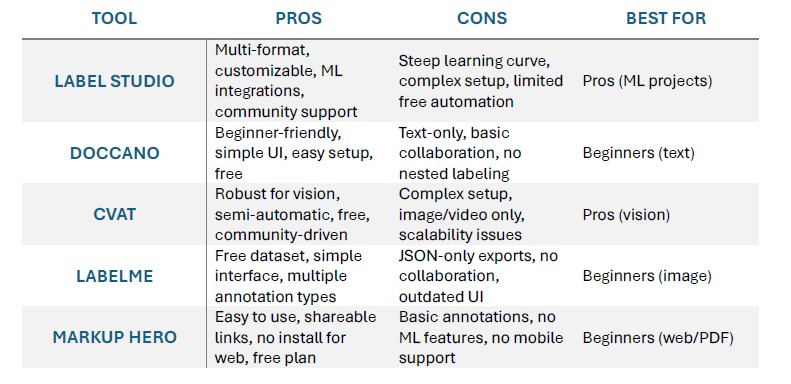
    In 2025, free annotation tools have become more powerful, offering robust features for text, image, video, and web annotation. This article highlights the top five free annotation tools, detailing their pros, cons, suitability for beginners or pros, and their best use cases, with a focus on customer collaboration.
    Whether you’re new to annotation or a seasoned pro, these tools can help you excel without breaking the bank.

    Free annotation tools democratize access to AI training, enabling freelancers, small teams, and students to contribute to cutting-edge projects. These tools support diverse tasks—labeling images, tagging text, or annotating videos—while offering collaboration features for seamless teamwork with clients or colleagues.
    With AI demand surging (job postings for AI skills grew 3.5x faster than overall jobs in 2024), free tools are a gateway for beginners to build skills and for pros to scale efficiently. Below, we compare five standout free tools in 2025, based on features, usability, and community feedback from sources like Reddit, X, and industry blogs.

    1. Label Studio

    An open-source, web-based tool for text, image, audio, and video annotation, widely used for machine learning projects.

    Pros:

    • Supports multiple data types (text, images, videos, audio).
    • Customizable workflows for tasks like object detection or sentiment analysis.
    • Strong community support with active GitHub contributions.
    •  Integrates with ML frameworks (e.g., PyTorch, TensorFlow).

    Cons:

    • Steep learning curve for non-technical users.
    • Limited automation in the free version.
    • Requires setup on local servers or cloud, which can be complex.

    Best For: Pros building custom workflows for complex AI projects.

    Why: Label Studio’s flexibility and multi-format support make it ideal for experienced annotators working on diverse datasets (e.g., computer vision, NLP). Its open-source nature allows pros to tailor it to specific needs, but setup complexity can challenge beginners.

    Customer Collaboration: Label Studio’s collaboration features allow multiple users to work on projects via shared workspaces. Teams at companies like Intel use it for internal data labeling, with APIs enabling integration into client pipelines for real-time feedback.

    1. Doccano

    An open-source, web-based tool focused on text annotation for NLP tasks like sentiment analysis and named entity recognition.

    Pros:

    • Beginner-friendly, simple web interface.
    • Supports text classification, sequence labeling, and sequence-to-sequence tasks.
    • Easy setup via PyPI installation.
    • Free with no usage limits.

    Cons:

    • Limited to text annotation; no image or video support.
    • Basic collaboration features; lacks advanced team management.
    • No relationship labeling or nested classifications.

    Best For: Beginners starting with text-based NLP projects.

    Why: Doccano’s intuitive UI and minimal setup make it perfect for newcomers to text annotation. Its simplicity suits small-scale projects, but pros may find it limiting for complex tasks or multi-format datasets.

    Customer Collaboration: Doccano supports multi-user projects, allowing teams to annotate concurrently. Small startups use it for quick dataset creation, sharing annotation guidelines directly in the app for client alignment.

    1. CVAT (Computer Vision Annotation Tool)

    An open-source tool by Intel, designed for image and video annotation, supporting tasks like object detection and segmentation.

    Pros:

    • Robust for computer vision (bounding boxes, polygons, semantic segmentation).
    • Semi-automatic annotation speeds up labeling.
    • Free and deployable via Docker.
    • Strong community support.

    Cons:

    • Complex local setup requires technical expertise.
    • Limited to image and video; no text or audio support.
    • Scalability issues for large datasets without paid cloud options.

    Best For: Pros in computer vision projects.

    Why: CVAT’s advanced annotation types and semi-automatic tools are tailored for experienced annotators working on image or video datasets. Beginners may struggle with its technical setup and lack of broader data support.

    Customer Collaboration: CVAT’s collaborative features allow teams to assign tasks and review annotations. Companies like Intel leverage CVAT for internal vision projects, with clients providing feedback via shared dashboards.

    1. LabelMe

    An open-source tool by MIT CSAIL for image annotation, offering a dataset of annotated images for computer vision tasks.

    Pros:

    • Free and open to external contributions.
    • Supports multiple annotation types (polygons, rectangles, circles, lines).
    • Simple web-based interface.
    • Community-driven dataset sharing.

    Cons:

    • Exports only in JSON format, limiting compatibility.
    • No built-in collaboration features.
    • Outdated UI compared to modern tools.

    Best For: Beginners in image annotation.

    Why: LabelMe’s simplicity and free dataset access make it ideal for newcomers learning image annotation. Pros may find its lack of collaboration and limited export options restrictive for large-scale projects.

    Customer Collaboration: Limited collaboration features mean LabelMe is better for solo work. Small research teams use it for academic projects, sharing annotated datasets via external platforms like Google Drive.

    1. Markup Hero

    A Chrome extension for annotating websites, PDFs, and images, focusing on visual feedback and collaboration.

    Pros:

    • Free plan with basic annotation features (arrows, text, highlights).
    • No installation required for websites; uses browser extension.
    •  Shareable links for easy collaboration.
    • Intuitive for non-technical users.

    Cons:

    • Limited to basic annotations; no advanced ML features.
    • Free plan caps storage and features.
    • Extension-based, so no mobile support.

    Best For: Beginners needing web or PDF annotation for client feedback.

    Why: Markup Hero’s ease of use and shareable links make it perfect for beginners collaborating on web projects or PDFs. Pros may need more robust tools for ML-specific tasks.

    Customer Collaboration: Markup Hero excels in client feedback, allowing users to share annotated screenshots via links without requiring client sign-ups. Agencies like Prontto use it for quick client reviews, streamlining web design feedback.

    Best for Beginners (Text Annotation): Doccano

    Why: Its simple web interface and easy setup (via PyPI) make it accessible for newcomers to NLP tasks like sentiment analysis. The lack of complex features ensures quick onboarding, though it’s limited to text.

    Best for Beginners (Image/Web Annotation): Markup Hero

    Why: Its Chrome extension and shareable links simplify web and PDF annotation for non-technical users. Ideal for freelancers collaborating with clients on web design or content review, but not suited for ML datasets.

    Best for Pros (Computer Vision): CVAT

    Why: Advanced annotation types (e.g., semantic segmentation) and semi-automatic tools cater to experienced annotators in computer vision. Its technical setup is a hurdle, but pros benefit from its precision and community support.

    Best for Pros (Multi-Format ML Projects): Label Studio

    Why: Its versatility across text, image, video, and audio, plus ML framework integrations, make it a go-to for pros handling complex AI projects. Customizable workflows suit large-scale, client-driven tasks.

    Best for Academic Image Annotation: LabelMe

    Why: Its free dataset access and simple interface are great for students or researchers starting image annotation. Limited collaboration makes it less ideal for team projects.

    top  5 free annotation tools in 2025
    Top 5 free annotation tools (2025) – Pros and Cons Summary

    By strategically leveraging the power of free and open-source data annotation tools, freelancers can significantly maximize their earnings. Here are some tips.

    Master Your Tools, Specialize Your Niche

    While general annotation skills are valuable, specialization is key to higher earnings. Each free tool excels in different areas.

    • For Computer Vision (Images/Video): Dive deep into CVAT, Label Studio. Master bounding boxes, polygons, semantic segmentation, and keypoint annotation. Consider specializing in niche areas like:
      • Autonomous Vehicles: Object detection (cars, pedestrians, traffic signs) in complex environments.
      • Medical Imaging: Annotating X-rays, MRIs, or CT scans for disease detection (requires domain knowledge, which commands higher rates).
      • E-commerce: Product categorization and attribute labeling.
    • For Natural Language Processing (Text): Become an expert in Doccano. Focus on:
      • Sentiment Analysis: Identifying emotions in text.
      • Named Entity Recognition (NER): Extracting specific entities like names, locations, or organizations.
      • Text Classification: Categorizing articles, reviews, or emails.
    • For Audio Data: While less represented in purely free tools, some platforms like Label Studio can handle audio. Develop skills in:
      • Transcription and Segmentation: Converting speech to text and marking speaker turns or significant events.
      • Sound Event Detection: Identifying specific sounds in an audio clip.

    By mastering a few tools and focusing on specific, high-demand annotation types, you become a go-to expert, justifying higher rates.

    Build an Impressive Portfolio

    Your portfolio is your resume. Since you’re using free tools, you have the advantage of creating numerous high-quality samples.

    • Showcase Diversity: Include projects using different tools and covering various annotation types (e.g., an image dataset annotated with bounding boxes in CVAT, a text dataset with NER in Doccano).
    • Highlight Accuracy and Speed: For each project, briefly explain the task, the tools used, and emphasize your accuracy and efficiency. If possible, quantify your output (e.g., “Annotated X images with Y% accuracy in Z hours”).
    • Create Your Own Datasets: Download public datasets (e.g., from Kaggle or Hugging Face) and annotate them using your chosen free tools. This demonstrates initiative and skill without relying solely on client projects.
    • Professional Presentation: Use a simple website, a dedicated Google Drive folder, or a GitHub repository to present your work neatly.

    Leverage Freelancing Platforms Strategically

    Many freelancing platforms (Upwork, Fiverr, PeoplePerHour) and specialized data annotation platforms (Appen, Telus Digital, Clickworker, Remotasks, Data Annotation Tech, Toloka AI, OpenTrain AI) have a high demand for data annotators.

    • Optimize Your Profile: Clearly state your expertise, the tools you’re proficient in, and your specialized niches.
    • Competitive Bidding (Initially): When starting, you might need to bid slightly lower to gain initial clients and positive reviews. Once you have a track record, increase your rates.
    • Focus on Quality: Platforms often monitor quality. Delivering highly accurate work consistently will lead to more invitations for projects and better-paying opportunities.
    • Seek Direct Clients: As you build your reputation, actively seek direct clients. This bypasses platform fees, allowing you to keep a larger share of your earnings. LinkedIn, industry forums, and AI/ML communities are great places to network.

    Embrace Continuous Learning

    The AI landscape is constantly evolving, and so are annotation techniques.

    • Stay Updated: Follow AI and ML news, blogs, and research. New data types and annotation challenges will emerge.
    • Explore Advanced Features: Even free tools often have hidden depths. Explore all features and shortcuts to boost your efficiency.
    • Learn Basic AI Concepts: A fundamental understanding of machine learning concepts (e.g., supervised learning, model bias) can help you understand why you’re annotating data in a certain way, leading to more intelligent and accurate work.
    • Consider Coding (Optional, but Beneficial): While not strictly necessary for most annotation roles, learning basic Python or scripting can unlock higher-paying projects, especially those involving automation or custom tool development.

    The best free annotation tools in 2025—Label Studio, Doccano, CVAT, LabelMe, and Markup Hero—cater to diverse needs, from text to computer vision. Beginners should start with Doccano for text or Markup Hero for web/PDF tasks due to their simplicity and collaboration features. Pros should opt for Label Studio or CVAT for their flexibility and ML integrations, ideal for complex AI projects. By leveraging these tools, upskilling in Python or domain expertise, and engaging with communities on X or Reddit, freelancers can maximize earnings and deliver high-quality datasets.

    Start exploring these tools today, and share your experiences below!


    Go back

    Your message has been sent

  • Mastering System Prompts for AI Training: A Guide to Excellence

    Mastering System Prompts for AI Training: A Guide to Excellence

    6–9 minutes

    System prompts are the backbone of effective AI training, serving as the guiding instructions that shape how an AI model interprets and responds to user inputs. Whether you’re a beginner dipping your toes into data annotation or a professional looking to elevate your skills, understanding system prompts is essential for creating high-quality AI interactions. In this tutorial, we’ll explore what system prompts are, how to become proficient in crafting them for AI training, and common pitfalls to avoid. Let’s dive in!

    A system prompt is a carefully crafted instruction or set of instructions provided to an AI model to define its behavior, tone, and approach to tasks. Think of it as the “rulebook” that tells the AI how to act—whether it’s answering questions like a friendly tutor, generating creative content, or analyzing data with precision.
    For example, a system prompt might look like:

    “You are a helpful, concise assistant who provides accurate answers in a friendly tone, avoiding jargon unless explicitly asked.”

    In AI training, system prompts are critical because they set the foundation for how the model processes inputs and generates outputs. They’re used in scenarios like fine-tuning large language models (LLM), guiding chatbots, or shaping responses for specific tasks like sentiment analysis or content generation.
    For data annotators, system prompts often serve as the framework for labeling data or evaluating AI outputs. They ensure consistency and clarity in how tasks are performed, whether you’re annotating text for intent classification or training an AI to follow specific guidelines.

    System prompts are the bridge between raw AI capabilities and tailored, user-friendly responses. A well-designed prompt can:

    • Improve the accuracy and relevance of AI outputs.
    • Ensure consistency across diverse tasks.
    • Align the AI’s tone and style with the intended use case (e.g., professional, casual, or creative).
    • Reduce errors by providing clear boundaries for the AI’s behavior.


    For freelancers in data annotation, mastering system prompts can set you apart in a competitive field. Creating accurate, complex, and rule-based system prompts is a kind of task you can find in platforms like Data Annotation Tech, as an example. Clients value annotators who can craft prompts that streamline AI training, reduce ambiguity, and produce reliable results.

    Becoming skilled at creating system prompts is a blend of understanding AI behavior, practicing clear communication, and iterating based on feedback. Here’s a step-by-step guide to help you excel:

    Understand the AI’s Capabilities and Limitations

    Before writing a prompt, familiarize yourself with the AI model you’re working with (e.g., GPT-based models, BERT, or others). Each model has unique strengths and quirks. For example, large language models like GPT excel at natural language tasks but may struggle with highly technical or niche topics without clear guidance. Research the model’s training data and intended use case to align your prompts with its capabilities.
    💡 Actionable Tip: If you’re working with a model like Grok 3, test simple prompts to see how it responds to different tones or levels of detail. This hands-on exploration helps you understand its baseline behavior.

    Start with Clear, Specific Instructions
    A good system prompt is precise and unambiguous. Avoid vague language and focus on defining:

    • Role: Who is the AI? (e.g., “You are a data science tutor.”)
    • Task: What should the AI do? (e.g., “Explain concepts in simple terms.”)
    • Tone and Style: How should the AI sound? (e.g., “Use a conversational, encouraging tone.”)
    • Constraints: What should the AI avoid? (e.g., “Do not use technical jargon unless asked.”)

    Example Prompt: “You are a patient, beginner-friendly data annotation tutor. Provide step-by-step guidance for annotating text data, using simple language and examples. Avoid assuming prior knowledge and do not use acronyms without explaining them.”

    💡Actionable Tip: Write your prompt as if you’re explaining the task to a colleague who’s new to AI. Test it with sample inputs to ensure clarity.

    Iterate and Test Your Prompts
    Prompt engineering is an iterative process. After writing a prompt, test it with various inputs to see how the AI responds. Look for:
    • Consistency: Does the AI follow the prompt across different queries?
    • Relevance: Are the responses on-topic and useful?
    • Edge Cases: Does the AI handle ambiguous or tricky inputs well?
    Example: If your prompt is for a customer service chatbot, test it with common questions, complaints, and even off-topic queries to ensure it stays on track.
    💡 Actionable Tip: Keep a log of your prompts and the AI’s responses. Note what works and what doesn’t, then refine the prompt to address gaps.

    Leverage Examples in Prompts
    Including examples in your system prompt (often called “few-shot prompting”) can significantly improve AI performance. Examples show the AI the desired output format and style.
    Example Prompt including Examples:

    “You are a sentiment analysis annotator. Classify the sentiment of customer reviews as positive, negative, or neutral. Provide a brief explanation for each classification.
Examples:

    • Review: ‘The product was amazing and arrived quickly!’ Sentiment: Positive. Explanation: The review uses enthusiastic language (‘amazing’) and mentions a positive experience (‘arrived quickly’).
    • Review: ‘The item broke after one use.’ Sentiment: Negative. Explanation: The review describes a product failure, indicating dissatisfaction.”

    💡 Actionable Tip: Use 2–3 diverse examples to cover common scenarios. Ensure they’re representative of the data the AI will encounter.

    Collaborate with Stakeholders
    If you’re freelancing, work closely with clients or project managers to understand their goals. Are they training a chatbot for e-commerce? A model for medical text analysis? Tailor your prompts to the project’s specific needs.
    💡 Actionable Tip: Ask for sample data or use cases to align your prompts with real-world applications. This ensures your prompts are practical and effective.

    Stay Updated on Best Practices
    Prompt engineering is an evolving field. Follow blogs, X posts, or communities like r/MachineLearning or AI-focused newsletters to stay informed about new techniques. For instance, recent discussions on X highlight the importance of “chain-of-thought” prompting, where you instruct the AI to break down complex tasks step-by-step.
    💡 Actionable Tip: Search X for terms like “prompt engineering tips” or “AI training prompts” to find real-world examples from practitioners.

    Even seasoned annotators can stumble when crafting system prompts. Here are key mistakes to watch out for and how to avoid them:

    Being Too Vague
    Pitfall: Prompts like “Be helpful” or “Answer questions” leave too much room for interpretation, leading to inconsistent or off-topic responses.


    Solution: Specify the role, task, and constraints. For example, replace “Be helpful” with “You are a technical support agent. Provide step-by-step troubleshooting for software issues in a polite, clear tone.”

    Overcomplicating Prompts
    Pitfall: Overly complex prompts with multiple instructions or conflicting goals can confuse the AI.


    Solution: Keep prompts concise and focused. Break complex tasks into multiple prompts if needed. For example, separate “summarize text” and “translate text” into distinct prompts for clarity.

    Ignoring Edge Cases
    Pitfall: Failing to account for ambiguous or tricky inputs can lead to poor AI performance.


    Solution: Test your prompt with edge cases (e.g., incomplete data, slang, or contradictory requests). Add instructions like “If the input is unclear, ask for clarification.”

    Neglecting Tone and Style
    Pitfall: Forgetting to define the AI’s tone can result in responses that feel robotic or misaligned with the audience.


    Solution: Explicitly state the desired tone (e.g., “formal,” “casual,” “empathetic”). For example, a prompt for a mental health chatbot might include “Use a compassionate, non-judgmental tone.”

    Not Reviewing Outputs
    Pitfall: Assuming a prompt works without testing it thoroughly can lead to errors in production.


    Solution: Regularly review AI outputs and refine prompts based on feedback. If you’re annotating, compare AI responses to ground truth data to ensure accuracy.

    As a freelancer in data annotation, your ability to craft effective system prompts can boost your reputation and efficiency. Here are additional tips to stand out:

    • Document Your Process: Keep a portfolio of prompts you’ve created and their outcomes. This showcases your expertise to clients.
    • Effective prompts often require balancing specificity with flexibility to handle diverse inputs.
    • Offer Prompt Optimization as a Service: Many clients need help refining prompts for their AI models. Position yourself as a prompt engineering specialist to add value.
    • Stay Ethical: Ensure your prompts don’t unintentionally bias the AI (e.g., reinforcing stereotypes). Review outputs for fairness and inclusivity.

    System prompts are the key to unlocking an AI’s potential, guiding it to deliver accurate, consistent, and context-appropriate responses. By understanding the AI’s capabilities, crafting clear and specific prompts, testing iteratively, and avoiding common pitfalls, you can master prompt engineering for AI training. For beginners, start with simple prompts and build confidence through practice. For freelancers, treat prompt crafting as a high-value skill that sets you apart in the data annotation field. Ready to get started? Write a sample prompt for a task you’re working on, test it with real data, and refine it based on the results.

    Share your experiences, suggestions, or questions in the comments below!


    Go back

    Your message has been sent